


 Warranty Policy
 FAQ
FAQ Download
 Company Events
 Business Events
 Vlog
Vlog Profile
 Why Premteco
 Certificates

 CN
CN EN
EN RU
RU ES
ES AR
AR

High-grade XR LED display-P1.9, P2.6, P2.9

Indoor Small Pitch Mini LED Display-P0.9, P1.25, P1.56

LED Floor Display-P2.5, P2.6, P2.9, P3.9, P4.8,P5.2,P6.25

Extremely Thin 4k LED Display

Fine Pitch LED Display-P2.5, P2, P1.8

Interactive LED Display-P1.2, P1.5, P1.8

Indoor Fine Pitch LED Display-P1.86, P2.0, P2.5, P3.076

Indoor Fine Pitch LED Display

Innovative COB LED Display - P0.78 P0.93 P1.25 P1.56 P1.87

Innovative 4K COB LED Display

Indoor Fine Pitch COB LED Display

Macro High Definition COB LED Display

Indoor Fine Pitch LED Display P0.7, P0.9, P1.25, and P1.56

IP68 Outdoor Front Access LED Display

Outdoor Front Service LED Display-P5, P6, P6.6, P8, P10

IP68 Outdoor Front Service LED Display-P6, P8, P10

Indoor Fully Front Service LED Display - P1.9, P2.6, P2.9, P3.9

Outdoor Front Access LED Display-P4.7, P6.3, P9.5

Outdoor LED Display Screen-P3.9, P4.8, P6.2, P7.8, P10.4

DIP LED Display-P10, P16, P20

SMD Outdoor LED Display-P1.9, P2.6, P3, P4, P6, P8, P10

Die-casting Slim Type Outdoor LED Display-P4, P5, P6.6, P8, P10, P16

IP66 Outdoor Front and Rear Access LED Display

Outdoor Front and Rear Access LED Display P5.71, P6.67, P8 and P10

Cutting-edge Outdoor LED Display Technology Solution

Outdoor Rental LED Display-P2.9, P3.9, P4.8

Outdoor Rental LED Display-P3.9, P4.8, P5.9

High-quality Outdoor Rental LED display-P2.6, P2.9, P3.9, P4.8

Outdoor Rental LED Display-P3.9, P4.8, P5.9

Outdoor Rental LED Display-P2.9, P3.9, P4.8

High Quality Outdoor Rental Transparent LED Display

High Quality Outdoor Rental Transparent LED Display

Indoor LED Display-P2.5, P3, P4, P5

Indoor LED Panel for Rental-P2.6, P2.9, P3.9, P4.8

Indoor LED Panel for Rental-P2.6, P2.9, P3.9

Indoor LED Panel for Rental-P2.6, P2.9, P3.9

Indoor LED Panel for Rental-P2.6, P2.9, P3.9, P4.8

LED Curtain Display-P10.4, P12.5, P15.6, P25, P31.2

Media Facade LED Display-P12, P15, P25, P31, P50

Translucent LED Display-P1.9, P2.8, P3.9, P7.8, P10


Outdoor LED Display Banner-P2, P3, P4, P5

Indoor LED Display Banner-P1.8,P2.5

Indoor LED Display Banner-P1.8,P2.5

Shelf LED Display for Supermarket and Retail Stores


Spherical LED Screen for Indoor and Outdoor Advertising

Oct. 07, 2026< Back to list
Curved walls, columns, circular structures, and other irregular surfaces can be difficult to fit with traditional rigid LED cabinets. Flexible LED displays use flexible PCBs, lightweight modules, and customized mounting systems to adapt to these shapes while maintaining visual performance.
However, “flexible” does not mean unlimited bending. Minimum bending radius, module structure, installation method, pixel pitch, brightness, protection rating, and maintenance design all affect real-world performance and reliability.
For system integrators, buyers, and rental companies, the key question is not simply how much a display can bend, but whether it can meet the required geometry, performance, and service life within the project constraints.
1. What Is a Flexible LED Display?
A flexible LED display is a modular direct-view LED display built on a flexible PCB rather than the rigid PCB used in conventional LED modules.
LEDs, driver components and control circuitry are mounted on the flexible module. The module can be curved within a specified mechanical limit and installed on a supporting structure designed to match the required shape.
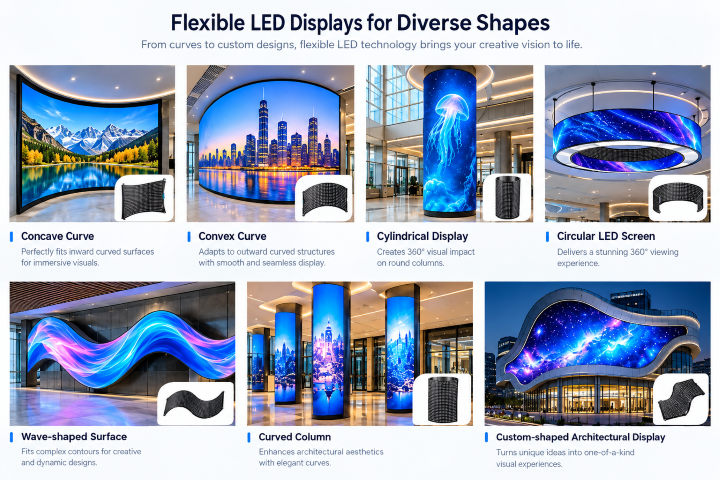
1.1 Shapes Flexible LED Displays Can Create:
(1) Concave curves
(2) Convex curves
(3) Cylindrical displays
(4) Circular LED screens
(5) Wave-shaped surfaces
(6) Curved columns
(7) Custom-shaped architectural displays
1.2 SMD and COB Options
Flexible LED displays are available with both SMD and COB packaging technologies, each with different strengths and limitations.
SMD solutions are generally more cost-effective, with flexible options for module design and pixel pitch. However, exposed LED packages provide less protection against physical impact.
COB offers a more integrated and durable surface, making it suitable for fine-pitch and close-viewing applications. However, it typically costs more, and its flexibility depends on the specific product design.
The choice between SMD and COB should consider cost, pixel pitch, viewing distance, durability, and bending requirements.
A flexible module is not self-supporting. Its bending capability is limited by the specified radius, while the complete display requires proper structural support and installation. Flexibility should therefore be evaluated together with module design, mounting method, and project requirements.
Want to learn more about COB vs. SMD? See our detailed comparison: [COB vs SMD LED Display: Which Technology Is Better for Your Project?]
2. How Does a Flexible LED Display Work?
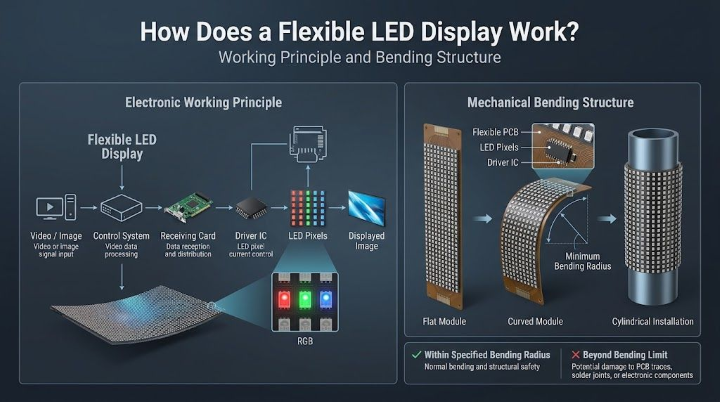
A flexible LED display works much like a conventional LED display. The main difference is that its LED modules are built on flexible PCBs, allowing them to bend and conform to curved structures.
The working process is straightforward:
(1) The control system sends video data to the receiving cards or integrated control electronics.
(2) The driver ICs process the data and control the current supplied to each LED pixel.
(3) The LED pixels produce light at different colors and brightness levels to reproduce the content.
(4) The flexible modules form the desired shape when installed on a suitable supporting structure.
The flexibility comes from the module's mechanical design, not a fundamentally different display technology. Each module has a specified bending limit, and exceeding it can damage PCB traces, solder joints, or components.
Therefore, the minimum bending radius or cylinder diameter is a key specification when selecting a flexible LED display.
3. Key Benefits of Flexible LED Displays
Flexible LED displays offer greater design freedom and installation flexibility than conventional LED cabinets. Their lightweight, bendable modules can adapt to complex structures and create shapes that rigid cabinets cannot easily achieve.
3.1 Flexible Shape and Design Freedom
Flexible modules can form curved, cylindrical, wave-shaped, and S-shaped displays, making them suitable for columns, curved walls, stages, and other creative structures.
3.2 Better Architectural Integration
Flexible LED displays can follow existing building geometry, allowing screens to integrate more naturally into retail stores, museums, exhibitions, and architectural media installations.
3.3 Lightweight and Thin Design
Flexible modules are typically thinner and lighter than conventional cabinets, which can simplify transportation, installation, and structural support. Total system weight should still be considered during project design.
3.4 Seamless Assembly and Customization
Closely assembled modules can create continuous display surfaces with fewer visible gaps. Customization options depend on module dimensions, pixel arrangement, cable routing, bending radius, and supporting structure.
4. Common Applications of Flexible LED Displays
Flexible LED displays are most valuable in projects where the screen needs to follow a curved surface, fit into an irregular structure, or become part of the architectural design rather than simply function as a flat video wall.
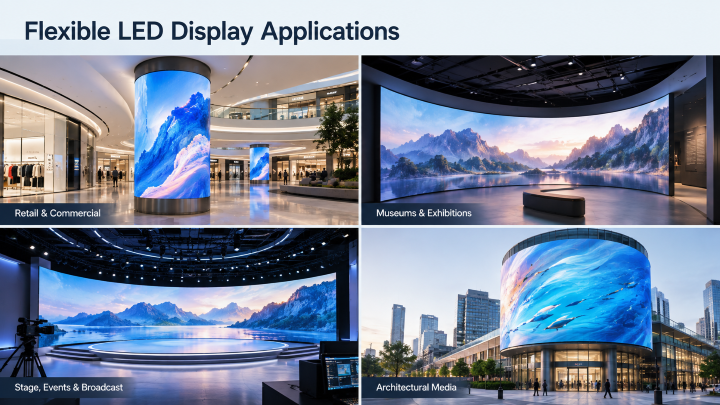
4.1 Retail and Commercial Spaces
Curved and cylindrical displays can wrap around columns, entrances, counters, or interior structures, helping brands create more immersive and visually distinctive environments.
4.2 Museums, Exhibitions and Showrooms
Flexible LED displays can be integrated into curved walls, sculptures, exhibition structures, and interactive installations to present content without being restricted to rectangular formats.
4.3 Stage, Events and Broadcast
Their ability to create curved, circular, and creative screen configurations makes them useful for stage backdrops, event sets, studios, and other environments where visual impact and flexible screen geometry are important.
4.4 Architectural Media and Advertising
Flexible LED can transform columns, building facades, and other non-planar structures into digital media surfaces. For DOOH and rental companies, this also creates differentiated display inventory that standard flat LED cabinets cannot easily replicate.
5. Flexible LED Display vs. Traditional LED Display
Flexible LED displays are not designed to replace traditional rigid LED displays in every application. The key question is whether the project requires the flexibility and design freedom they provide.
The two solutions differ mainly in display geometry, installation requirements, maintenance, customization, cost efficiency, and project risk. The following comparison highlights where each type has an advantage:
Factor | Flexible LED Display | Traditional Rigid LED Display |
Surface | Curved / irregular | Mainly flat |
Creative freedom | High | Moderate |
Structural complexity | Higher | Lower |
Installation | Requires geometry-specific support | Usually standardized |
Maintenance | Depends heavily on access design | Generally easier |
Cost efficiency | Better for complex shapes | Better for standard flat walls |
Rental use | Suitable for creative events | Better for conventional rental |
Customization | High | Usually lower |
Project risk | Higher if geometry is poorly engineered | Easier to standardize |
For a standard rectangular video wall, flexible LED is often unnecessary. A conventional cabinet can provide a simpler installation, easier maintenance and more predictable project cost.
If the project does not need flexibility, do not pay for flexibility.
6. Key Specifications To Consider Before Buying
Not every specification carries the same weight in every project. For flexible LED displays, buyers should focus on the parameters that directly affect fit, image quality, reliability, and long-term operation.
6.1 Pixel Pitch
Pixel pitch determines pixel density and viewing distance. Smaller pitches provide finer images but usually cost more. Choose based on the actual viewing distance and content requirements rather than simply selecting the smallest available pitch.
6.2 Minimum Bending Radius
This is one of the most important specifications for flexible LED displays. Ask for the minimum bending radius or minimum cylinder diameter, rather than relying on terms such as “180° flexible.”
The display must be able to achieve the required geometry without exceeding its mechanical limits.
6.3 Brightness and Refresh Rate
Brightness should match the installation environment, while refresh rate becomes particularly important for camera-facing applications.
For indoor displays, excessive brightness can reduce viewing comfort and increase power consumption. For rental, broadcast, and event applications, confirm that the selected refresh rate is compatible with the cameras being used.
6.4 IP Rating and Environmental Protection
For outdoor or semi-outdoor projects, check the front and rear IP ratings, connector protection, cable routing, and drainage design. The entire system—not just the LED module—should be suitable for the installation environment.
6.5 Maintenance and Weight
Consider how easily damaged modules and key components can be accessed and replaced after installation. Front maintenance can be especially important when rear access is limited.
Also evaluate the total installed weight, including the modules, supporting structure, power supplies, cables, and mounting hardware.
6.6 Power Consumption
Compare both maximum and average power consumption. Maximum power helps with electrical system sizing, while average power is more useful for estimating long-term operating costs.
The test conditions should always be clearly stated.
7. Flexible LED Display Installation and Maintenance
Proper installation is critical to the performance and service life of a flexible LED display. Unlike rigid LED panels, flexible modules must be installed according to their specified bending limits and supported by a structure that accurately matches the intended shape.
7.1 Installation Considerations
Before installation, verify the bending radius, module orientation, mounting method, cable routing, structural tolerance, and maintenance access. The supporting structure should ensure consistent contact and alignment.
Never exceed the specified bending radius or apply excessive pressure to the PCB, LEDs, or connectors. Carefully align adjacent modules, as small gaps or height differences can be noticeable on curved, high-resolution displays.
For COB flexible displays, handle modules carefully to avoid unnecessary bending, twisting, or impact.
7.2 Maintenance Considerations
Maintenance should be considered during installation design, not after completion. Ensure that modules, power supplies, receiving cards, and cables are easily accessible and replaceable.
For rental applications, establish a standard replacement process covering removal, replacement, calibration, and testing. Keeping compatible spare modules and critical components on hand can also reduce downtime.
A well-designed flexible LED display should combine the required curved geometry with reliable operation, accurate alignment, and practical long-term maintainability.
8. Premteco Offers Flexible LED Display Solutions
FL Series
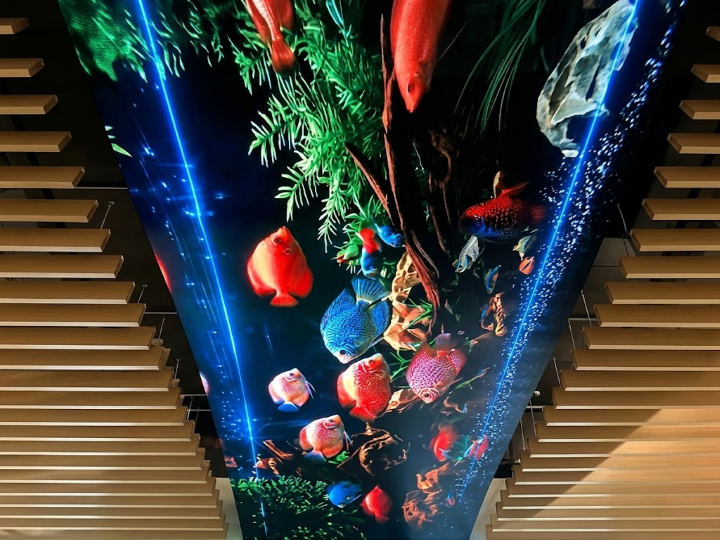
Note: Premteco FL P2.5 Flexible LED Display in Saudi Arabia
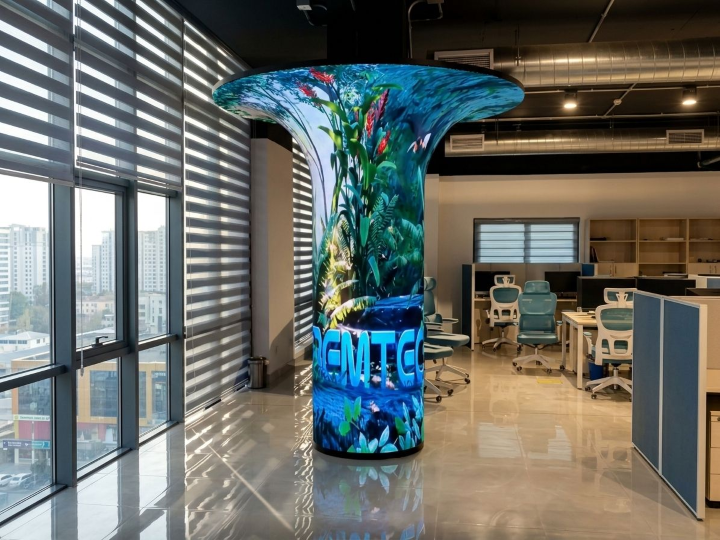
Note: Premteco FL P2.5 Flexible LED screen in Damman Saudi Arabia
Key parameters:
Packaging Technology | SMD (Surface-Mounted Device) |
Pixel Pitches | P1.5, P1.88, P1.875, P2, P2.5, P3, P3.07, P4, P5 |
Brightness | 500 ~ 600nits |
Refresh Rate | 1920 ~ 3840Hz |
Cabinet Size | Customized |
Cabinet Weight | 20 kg/m2 |
Why Choose FL Series?
Flexible & Custom Shaping – Flexible materials support concave, convex, S-shaped, and circular designs, with a minimum diameter of approximately 0.48 m.
Versatile Pixel Pitch Options – Available from P1.5 to P5 to meet different resolution and viewing-distance requirements.
Ultra-Slim & Double-Sided Design – The module is only 30 mm thick, with double-sided configurations available at approximately 130 mm total thickness for creative installations.
Reliable Performance & Protection – Designed for stable operation on irregular surfaces, with secure component mounting and optional IP68 protection for outdoor modules.
8. Conclusion
Flexible LED displays are a practical solution when conventional rigid LED displays cannot follow the required shape. The key is not simply choosing a flexible module, but making sure the curvature, viewing distance, environment, maintenance and overall system design work together.
In short: define the shape first, then choose the right LED solution.
If you are planning a curved, cylindrical or custom-shaped LED display, contact Premteco to discuss your project requirements and find a solution that fits both your design and performance needs.
Control Room LED Video Walls: How to Choose the Right Display
Flip-Chip vs Wire-Bond COB LED Displays: Key Differences
LED Display Grayscale: Bit Depth and Image Quality Explained
How to Choose an Outdoor LED Billboard: Pixel Pitch, Brightness, IP Rating and Power Consumption
COB vs MIP for P0.9 LED Video Wall: Which Is Better?
Premteco: special-shaped screen to present a different
How does the LED display follow the 5G trend?
Premteco introduces new design rental screen
Premteco P8 Perimeter LED Screen for Stadium in Canada
Premteco P10 Outdoor Fixed LED Display in Australia
Premteco P1.5 Indoor Full Color LED Screen in Australia
Premteco P8 Outdoor LED Trailer Screen in Australia
Premteco P2.5 Indoor LED Banner Screen in Australia
Premteco P4.8 outdoor LED screen in Qatar
Premteco P1.9 Indoor HD LED screen in Kuwait
Premteco P3.9 Outdoor Rental LED Display in Austria